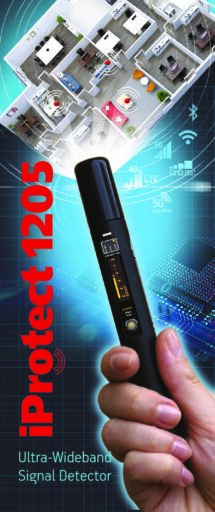

Evolution of Threats
The evolution of mobile communications (4G/5G) and the widespread availability of wireless standards such as Wi-Fi and Bluetooth have led to a shift in the methods and technical solutions used for covert information gathering (surveillance devices or “bugs”). Modern mobile infrastructure provides unprecedented opportunities to transmit information in real-time over the Internet without the need for a nearby monitoring post. Furthermore, Wi-Fi and Bluetooth standards ensure high-quality transmission and a high level of stealth due to the dense saturation of these signals in modern environments.
Additionally, the mass production of electronic components and developer boards for IoT (Internet of Things) systems using these standards has accelerated the creation of professional-grade surveillance devices, making them easily accessible on the open market.
Signal detectors allow for the detection of any radio-frequency means of covert information gathering while simultaneously localizing radiation sources of all the types mentioned above. The iProtect 1205 is characterized by a wide detection band and a range of auxiliary functions to speed up the pinpointing of a source’s location.
Features
- Quick and easy detection of various RF bugging devices, including VHF/UHF/SHF audio and video transmitters, mobile network transmitters (GSM, 3G, 4G, 5G), Wi-Fi/Bluetooth transmitters, as well as stationary, vehicle-mounted, and body-worn transmitters.
- Wide frequency range: 50 MHz to 15 GHz.
- Detects signals regardless of the modulation type or the nature of the information being broadcast.
- 3 Operating Modes:
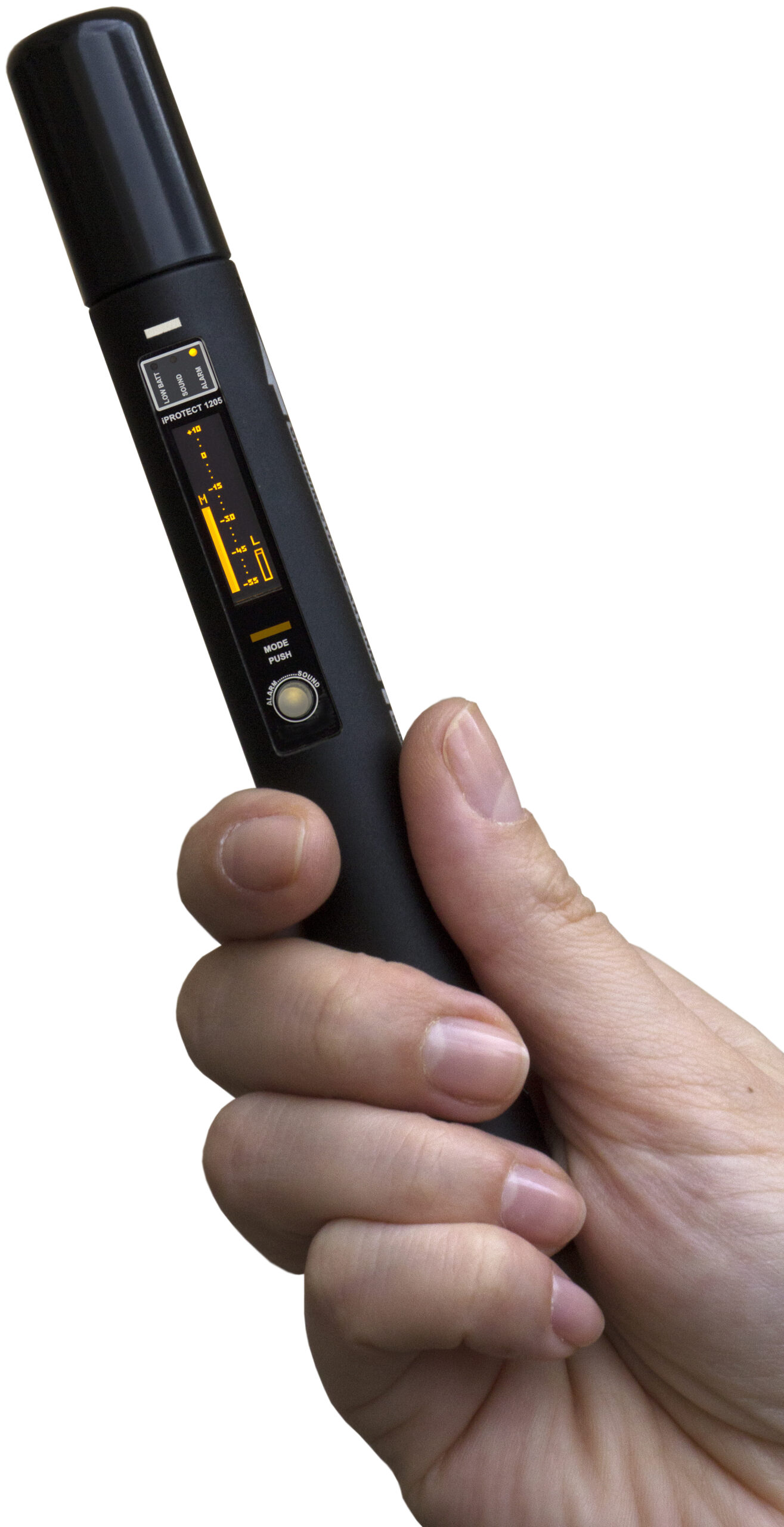
- SILENT: Visual level indication on the screen only.
- ALARM: Audio alert combined with visual level indication.
- SOUND: Demodulates the amplitude component (audio monitoring) with visual level indication.
- Dual-scale display for easier detection and localization:
- Modulation Level (M): High sensitivity for detecting signals from a greater distance.
- RF Level (L): For precise physical localization of the signal source.
- Built-in omnidirectional antenna.
- Compact, portable design with a durable duralumin enclosure.
- Powered by a single AA (LR06) battery.
- Low battery indicator.
- Battery life: 10-15 hours active use; up to 25 hours standby.
APPLICATION & SEARCH THEORY
Types of Surveillance Devices
Covert listening devices can be categorized by how they obtain and transmit data:
- Wired: Transmit info via physical wires.
- Recorders: Store data to internal memory.
- RF Bugs: Radio-frequency transmitters.
- Hybrid: Combinations (e.g., store-and-forward via radio or wire).
- Vibro-acoustic: Contact methods (stethoscopes).
- Trackers: GNSS-trackers for vehicle/cargo coordinates.
What is an RF Signal Detector?
An RF detector measures and displays the total level of radio emission in its immediate vicinity. The search is performed by “probing” objects, surfaces, and areas of a room. If a radio source is present, the detector’s scale will rise. The operator localizes the source by finding the point of maximum signal strength.
Note: Many “friendly” signals (Wi-Fi routers, laptops, etc.) may exist in the area. The operator’s goal is to distinguish a threat from these routine signals.
Specification
| Frequency Range | 50 MHz–15 GHz |
| Sensitivity | -50 dBm |
| Operating Modes | SILENT, ALARM, SOUND |
| Level Scales | Modulation Level (M), RF Level (L) |
| Control buttons | Power, Mode |
| Display | OLED 128×32 |
| Battery life | 10-15 hours active use; up to 25 hours standby |
| Dimensions | 172 x 19 mm |
| Current consumption | 80 – 150 mA |
| Power | 1 battery AA (LR06) |