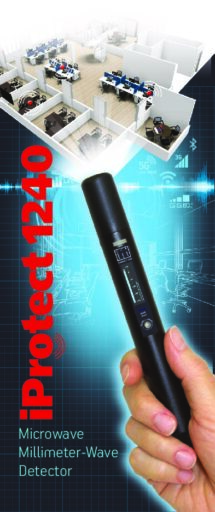

The evolution of mobile communications and the emergence of 4G/5G have changed the methods and technical solutions used for covert information retrieval (bugging devices). Modern mobile network infrastructure provides unprecedented possibilities:
- transmission of audio, visual, and other information in real time
- wide bandwidth ensuring high-quality transmission
- wide network coverage
- unlimited data transmission distance, and absence of the necessity to deploy a monitoring post near the surveillance object
- remote control capability, accumulation of information, and accelerated transfer to increase concealment
- the possibility of storing information on cloud services with full anonymity
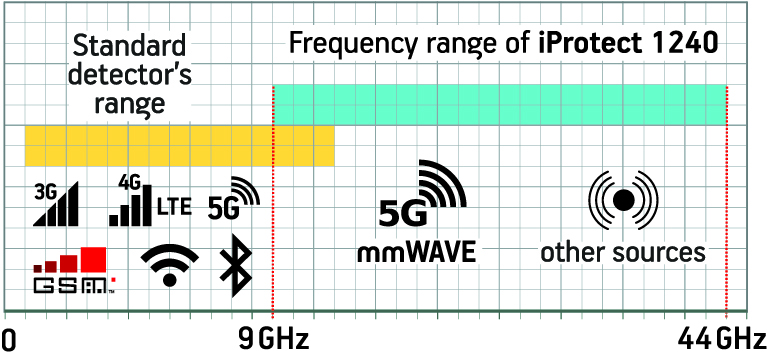
Additionally, the mass production of electronic components and developer boards for IoT systems speeds up the creation of professional bugging devices and makes them widely available. To detect radio-frequency covert surveillance devices, including those operating via 4G/5G channels, field detectors, mobile signal detectors, and specialized spectrum analyzers are used. Typically, they cover frequency ranges up to 6 GHz or 12 GHz and can effectively detect signals within those limits. However, several 5G bands operate at higher frequencies, and such signals cannot be detected by standard search equipment. These are the millimeter‑wave (mmWave) bands. Although these bands have limited penetration through walls and structures and are mostly used outdoors or in areas with large crowds, there remains a possibility they may be used for illegal information transmission. Therefore, during a professional bug sweep, detecting and localizing signal sources in the millimeter-wave range becomes essential.
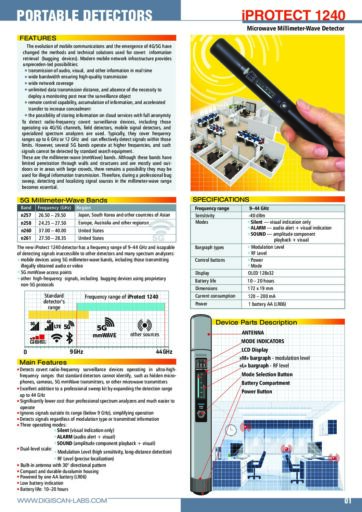
5G Millimeter-Wave Bands:
| Band | Frequency (GHz) | Region |
| n257 | 26.50 – 29.50 | Japan, South Korea and other countries of Asia |
| n258 | 24.25 – 27.50 | Europe, Australia and other regions |
| n260 | 37.00 – 40.00 | United States |
| n261 | 27.50 – 28.35 | United States |
Main Features
- Detectscovert radio-frequency surveillance devices operating in ultra-high frequency ranges that standard detectors cannot identify, such as hidden micro phones, cameras, 5G mmWave transmitters, or other microwave transmitters
- Excellent addition to a professional sweep kit byexpanding the detection range up to 44 GHz
- Significantly lower cost than professional spectrum analyzers and much easier to operate
- Ignores signals outside its range (below 9 GHz), simplifying operation
- Detects signals regardless of modulation type or transmitted information
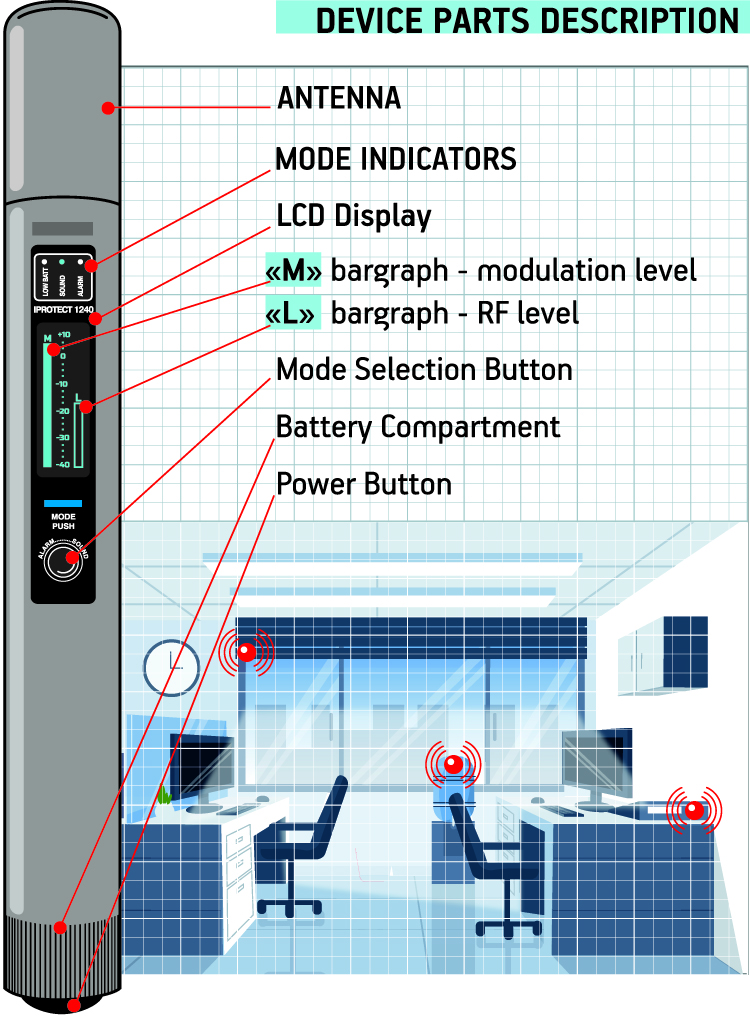
- Three operating modes:
Silent (visual indication only)
ALARM (audio alert + visual)
SOUND (amplitude component playback + visual)
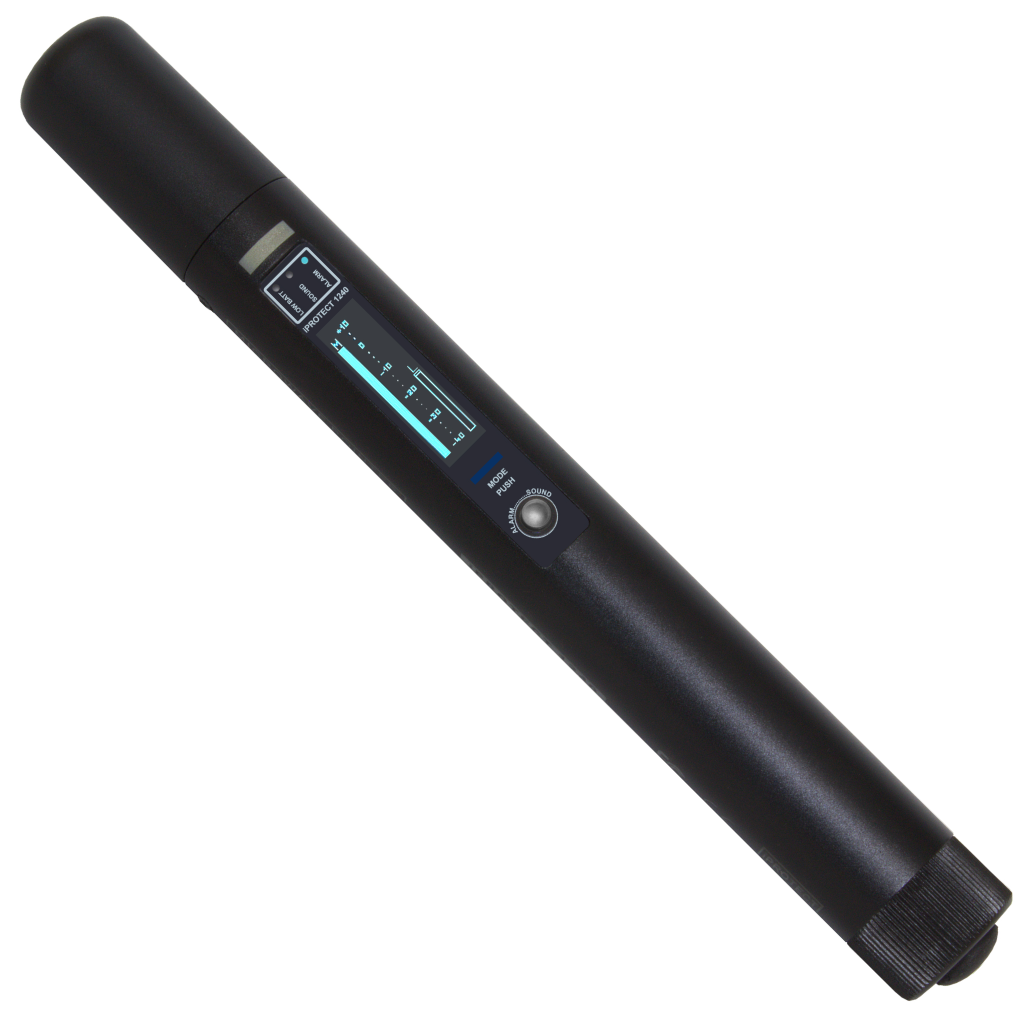
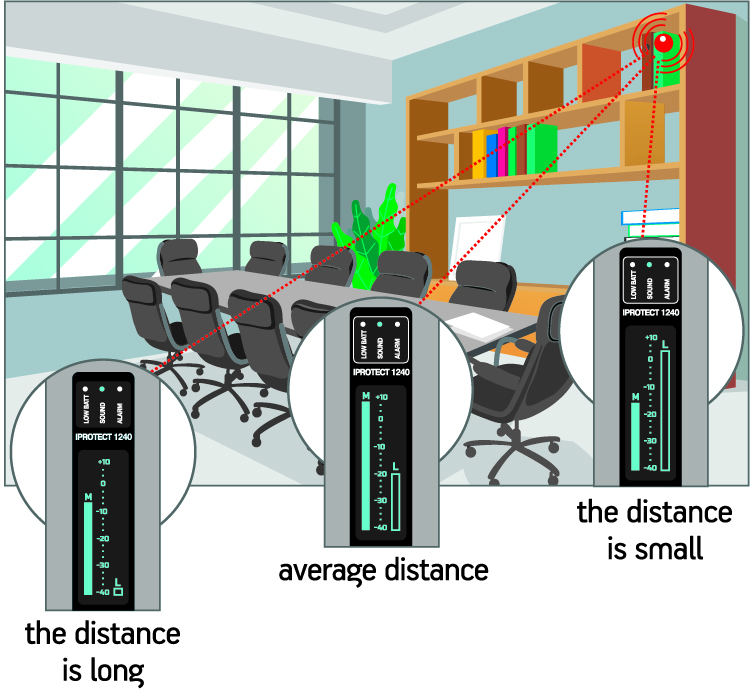
- Dual-level scale:
Modulation Level (high sensitivity, long-distance detection)
RF Level (precise localization)
- Built-in antenna with 30° directional pattern
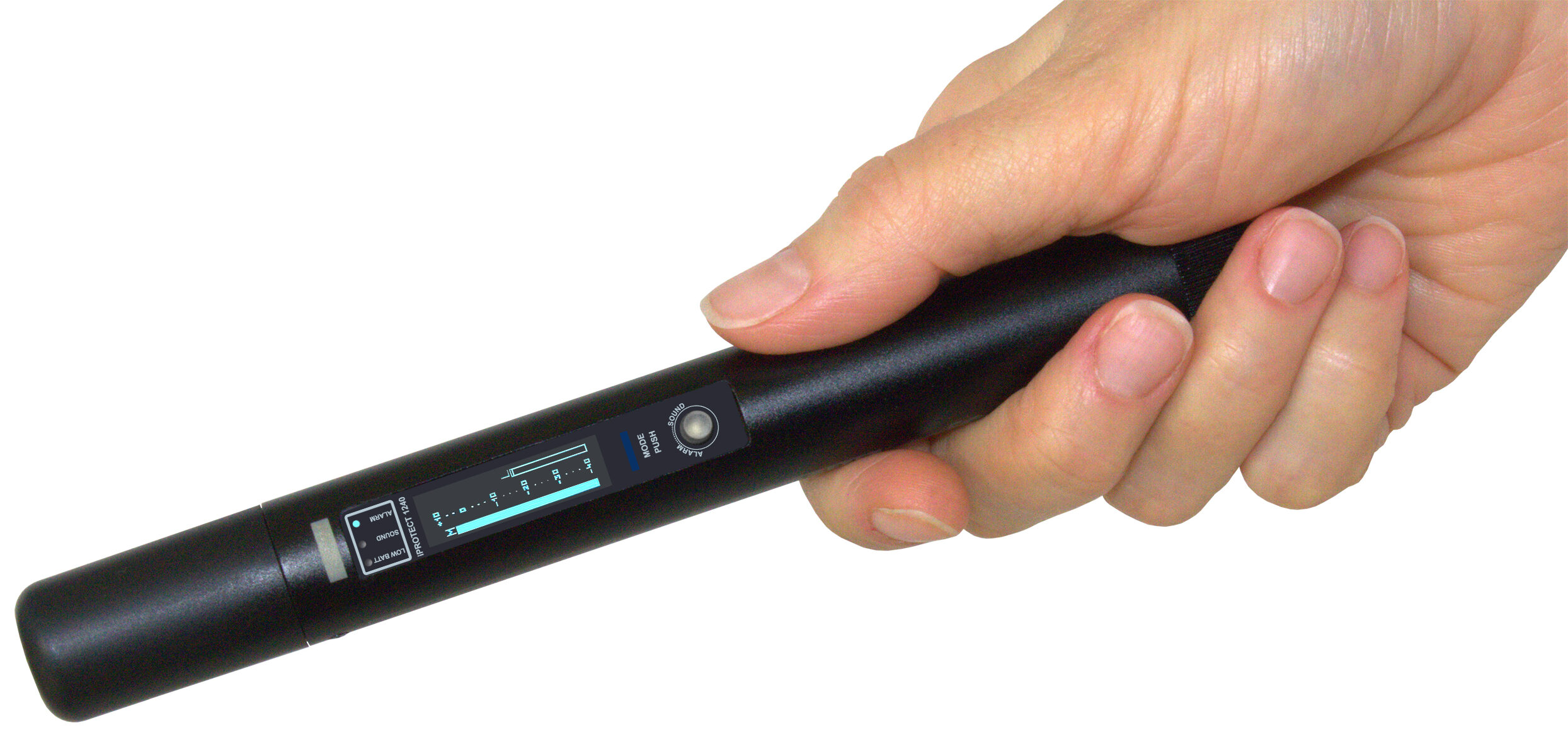
- Compact and durable duralumin housing
- Powered by one AA battery (LR06)
- Low battery indication
- Battery life: 10–20 hours
Specification
| Freaquency range | 9–44 GHz |
| Sensitivity | –40 dBm |
| Modes | SILENT — visual indication only |
| ALARM — audio alert + visual indication | |
| SOUND — amplitude component playback + visual | |
| Bargraph types | Modulation Level, RF Level |
| Control buttons | Power, Mode |
| Display | OLED 128×32 |
| Battery life | 10–20 hours |
| Power | 1 battery AA (LR06) |
| Current consumption | 120–200 mA |
| Dimensions | 172 × 19 mm |